Wednesday, August 31, 2011

Eschalot and Honey Terrine


First published Canberra Times 31 August 2011.
Parisians don’t compromise on food and the mind-boggling choices available in its famous street markets are a powerful expression of this. The abundant selection of mouth-watering, ready-made foods means you may never need to lift a saucepan again. Locals are spoilt for choice with anything from rare, cave-ripened cheeses to freshly slaughtered game meats, creating a feast for the eyes and stomach.
A special discovery of mine made on a recent trip to Paris, is Le Marché des Infants Rouge, off the Rue de Bretagne in the Marais. This is reputed to be the oldest food market in Paris, built in 1615 under the rule of King Louis XIII. The name translates as  “The Market of the Red Children”, and is believed to come from its proximity to a nearby 17th century orphanage where the children wore red uniforms. 
This little gem is hidden down a laneway among a labyrinth of fixed stalls which sell gourmet foods of all descriptions. Here, the merchants noisily call out to each other, joking and singing and chatting with their regular customers. I find it hard to resist the plump perfumed strawberries or a choice of cheeses, the like of which I’ve never seen. The fresh North Sea fish sitting on ice beckons, but the charcuterie with its awesome array of delicious terrines is the drawcard for me.
The friendly woman who greets me at the counter cooks these terrines herself and is very willing to provide tasty morsels and to decipher the ingredients of some of the more unusual combinations. After a funny and good natured discussion in pidgin Frenglish, I am persuaded to choose the eschalot and Parisian honey terrine which looks light and delicious nestled in among the heavier meats.
She explains that this is one of her most popular terrines and describes to me the love affair Parisians have with honey. I learn that many Parisians keep bees right in the heart of Paris where there are fewer pesticides than in the French countryside where honey is traditionally produced. The flowers and plants are continually changed and revitalised, creating fresh pollen for the bees. It’s difficult to imagine that there are beehives atop the Galleries Lafayette, the Paris Opera and in many of the central parks including the Tuilieries, but they are there.
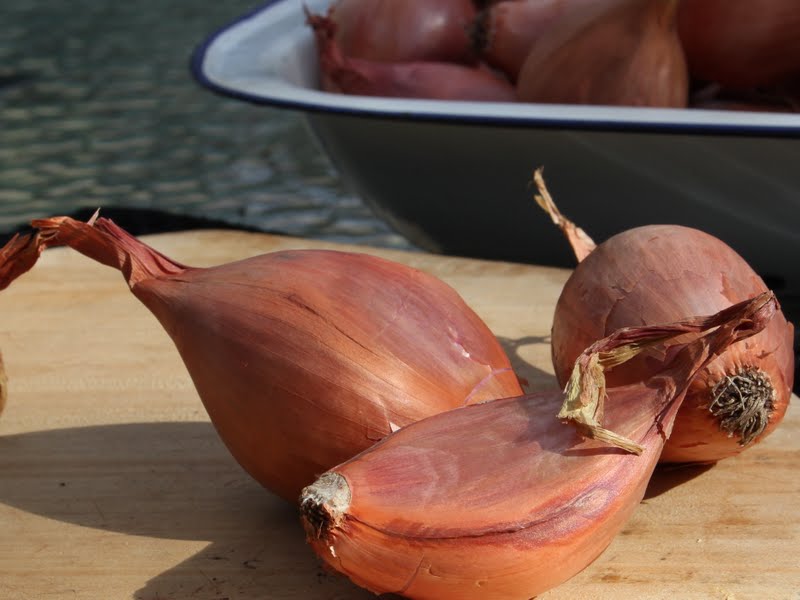
The eschalots used in this terrine are usually sold in Australia as “French eschalots”, and resemble small brown onions. To add some confusion, they are sometimes labelled as “shallots”. Be careful not to buy the long green shallots that are often used in Asian cooking.  You need about 800g of eschalots for this recipe - I paid around $8.00 for this quantity.  
This terrine is light, delicately sweet and is perfect for a lunch with some leafy greens, dressed with a white wine vinaigrette. It’s best eaten warm or at room temperature and served with the reduced honey sauce and a dollop of crème fraiche. The flavours in this terrine are great for a spring lunch matched with a light and subtle fruity white, like Viognier Nouveau 2010 from Clonakilla.

800g eschalots
2 tbsp olive oil
250ml of white wine
3 tbsp honey, light flowery honey is best
1 large sprig rosemary
1 tbsp cornflour
1 cup crème fraiche
6 eggs, beaten
Pinch of salt and pepper
Pinch of ground nutmeg
1 tbsp balsamic vinegar
Extra crème fraiche to serve
Preheat the oven to 180C.
Peel the eschalots, cut them lengthways into thin slices and sauté in the olive oil in a large frying pan. Add the wine, honey and rosemary, mixing to combine. Simmer, covered for 20 minutes on a low heat.
While the eschalots are cooking, mix the cornflour and crème fraiche together in a large bowl. Add the beaten eggs, the salt and pepper and nutmeg and mix well.
When the eschalots are cooked, strain the honey juice, pressing down on the eschalots to extract all remaining juice. Mix the eschalots into the crème fraiche mixture.
Butter a terrine or loaf pan well, 25cm x 10cm x 7cm high. Pour the mixture into the terrine. Place the terrine in a pan half filled with boiling water and bake in the oven for 40 minutes.
Just before serving add the balsamic vinegar to the reserved juice and boil down for 3 minutes. While the terrine is still warm unmould and slice with a sharp knife. If you have an electric knife, use it to slice. Add a few rosemary leaves to the honey sauce and serve separately at the table. Photos by Steve Shanahan


Wednesday, August 24, 2011

Hot Meringues


First published Canberra Times 24 August 2011.
Biting into a crunchy meringue is a wonderful sensation - that crispy outside and marshmallowy soft centre melts away to nothing on your tongue.  There is no better place to eat them than in France, where patisserie shelves are piled high with these light, crispy confections. They are usually made in large freeform shapes in a subtle, swirly palette of colours and flavours.
The French were one of the first countries in Europe to make meringue, known as "pets" back in the middle ages. The literal translation of pets is "fart" because the meringue texture is as light as air. I think if we venture into the nearest cake shop here and ask for some "farts" we might not get the reaction we are expecting.
The earliest recipes call for the egg whites to be whisked with birch twigs and shaped into tall sculptures to adorn feasting tables for nobles and royalty . The meringue was used as a structural element to provide support for large edible centrepieces.
The meringue has long since ceased to be the perogative of the rich and powerful. Which 1960's kid could resist the local cake shop with its heady scent of vanilla essence and its orderly rows of pink piped meringues lined in formation? Where would Australian popular culture be without its iconic Aussie pav?
This recipe breaks the "rules" for meringue-making as it strays from the traditional and more well known methods by combining  egg whites, sugar and boiling water at the beginning of the recipe. The end result is not as dry and crisp as traditional methods, but has a crunchy outside and a soft marshmallow centre. This is a perfect winter dessert when eaten warm from the oven, combined with an oozy, warm chocolate sauce and whipped cream.
French meringue is the most popular method used by home cooks, using caster sugar beaten into egg whites, and is the usual way to make our famous pavs. Italian meringue is made with a pre-made boiled sugar syrup, which is added to beaten egg whites. It results in a much more stable consistency and is used in pastries and pies to prevent collapsing. On the other hand, Swiss meringue is made by whisking egg whites and sugar over warm water and then whisked until cooled and then baked.
As is usual for meringues, the egg whites should not contain any yolk or they won't whip up. You can pipe them or shape them between two dessertspoons to form large mounds. I like to use the dessertspoon method because it makes them puffy and decadent looking.

You can add Tia Maria or any liqueur you like to the chocolate sauce. I add a few fresh berries to the plate and some maple syrup coated macadamias for colour and crunch. Don’t forget to leave your eggs out of the fridge to warm to room temperature which allows the whites to whip to a greater volume.

Meringues
3 egg whites
2 cups of icing sugar mixture
½ cup of boiling water
¾ cup thickened cream, whipped
Chocolate sauce
100 g dark chocolate, chopped
½ cup thickened cream
2 tbsp Tia Maria
2 tbsp boiling water
Preheat the oven to 180C.

Beat egg whites, icing sugar and water in a small bowl of your electric mixer for about 8 to 10 minutes or until firm peaks form.

Using a large metal spoon, drop 8 equal portions of mixture onto large baking trays lined with baking paper. Bake on lowest shelf, in moderate oven, for about 20 minutes or until browned slightly and firm to touch.

For the Chocolate sauce, combine all ingredients in a small saucepan and stir over low heat without boiling and chocolate is melted.

Gently lift the hot meringues from the oven tray to serving plates. Top with whipped cream and a large drizzle of Chocolate sauce. Add berries or nuts to taste and dust with icing sugar.
Photos  by Steve Shanahan.


Wednesday, August 17, 2011

Cola spare ribs


First published Canberra Times 17 August 2011. Each year, as Canberra approaches the end of winter, we are sent a slightly warmer spell of weather that lulls us into believing that the big chill is coming to an end. It was during this winter hiatus that I fired up the barbecue to cook these jammy ribs.

We are also selling our house and I didn’t want to dirty my clean oven. Given that the weather was only tricking us, it’s looking like some shivery dinners coming up for the next little while for us.

I first tried these pork ribs while we were on holidays last year in Mission Beach, North Queensland, and was surprised to come across them again while we were in France. I’m told they are very popular in France, eaten during the summer months, cooked in the outdoor ovens.

As I am not a big fan of cola, I was pretty sceptical when I found out how these ribs were cooked. With cola’s reputation of stripping paint, cleaning concrete and car engines, I had nasty visions of it eating holes in my stomach. But in saying that, I’ll give most things a go. Because you cook the ribs in the cola liquid, then discard it - probably not worth getting twisted in knots about the whole cola thing.

The ribs are pre-cooked in a cola, cinnamon and star anise liquid. It’s not surprising that this trio of flavours matches the pork perfectly. I also added a knob of ginger and some black pepper and a small amount of orange juice to give only a slight sweetness without being overly cloying.

They need to be prepared in advance, so make plenty of extras. They will keep cooked in the fridge for a few days, ready to reheat when you get home from work. I teemed this with a crunchy noodle salad that cuts through the sweetness of the pork nicely. This is great picnic or watching the footy food. The ribs are best eaten with your fingers with lots of paper serviettes at the ready.

2kg pork spare ribs
1.5 litres of cola
4 star anise
½ cup of orange juice
2 cinnamon sticks
small knob of ginger
cracked black pepper
salt

Marinade1 small glass of sherry
2 tbsp of honey
2 tsp light soy sauce
1 tsp grated ginger
few drops of sesame oil
½ cup of tomato sauce
juice of ½ lemon
2 fresh or dried chillies

Preheat the oven to 180C. Place the pork ribs, with the cola, star anise, black pepper, salt, orange juice and cinnamon in a large, deep, ovenproof casserole dish over medium heat. Bring to the boil. Transfer dish to the oven for about 2 hours or until the pork is tender when tested with a knife. Remove pork to a plate and cool slightly. Discard the cola liquid.

If any of the ribs have curled up, make a short slit with a sharp knife in between the ribs and they will flatten out.

To make the marinade, whisk ingredients together in a bowl. Place the pork ribs in a large ceramic or glass dish, and pour the marinade over. Cover pork with plastic wrap, and set aside in the refrigerator for 1 hour.

Preheat a covered barbecue to medium heat. Cook the pork spare ribs with the cover down for 10 to15 minutes, basting during cooking with the marinade. Photo by Steve Shanahan